
Shared money
Kakeibo for couples
Almost everything written about this method assumes one wallet. Two people spending from one household need one ledger, a way to split it that survives a real gap in income, and a monthly reflection that is a conversation rather than a trial.
Kakeibo was written for a single household account, and most of what gets published about it still talks as if only one person ever opens the book. Two incomes, two sets of habits and two people who each reach for the same card is the more common case, and it needs a version of the method that says who writes what down and what happens when the two of you disagree about it.
One ledger, not two
The single most useful decision a couple can make is to keep one shared ledger rather than two private ones, even where the bank accounts stay separate. Two trackers produce two partial accounts of the same household, and neither one can answer the only question kakeibo actually exists to answer, which is where the money went this month. A shared grocery bill logged twice, once in each app, is not twice the information. It is the same fact, unreconciled, in two places that will eventually disagree.
One ledger also settles an argument before it starts, because the figures are no longer "my numbers" against "your numbers". They are the household's numbers, and a disagreement about them is a disagreement about a shared fact rather than about whose tracking is more accurate.
The case against one person keeping the book alone
It is tempting to hand the ledger to whichever partner is already better with money, and it is close to the worst option available. The mechanism behind kakeibo is not the ledger itself, it is the act of writing an entry at the moment you decide to spend. Hand that act to one person and only one person gets the benefit of it. The other partner keeps spending exactly as before, now with someone else quietly tallying the consequences, and that arrangement produces resentment on a schedule you can set your watch by.
It also creates a single point of failure. One person holds the only complete picture of the household's money, which means one person carries the entire weight of every financial conversation, and the other has no independent way to check a number they are still asked to agree to. A ledger that only one partner can read is not a shared budget, it is a report one partner delivers to the other.
Who records what
Whoever spends, records, at the time, into the same shared ledger. That is the whole rule, and it survives contact with real life better than any more elaborate division of labour.
- Log your own spending. Not your partner's, because an entry made by someone who was not there is a guess with a number attached.
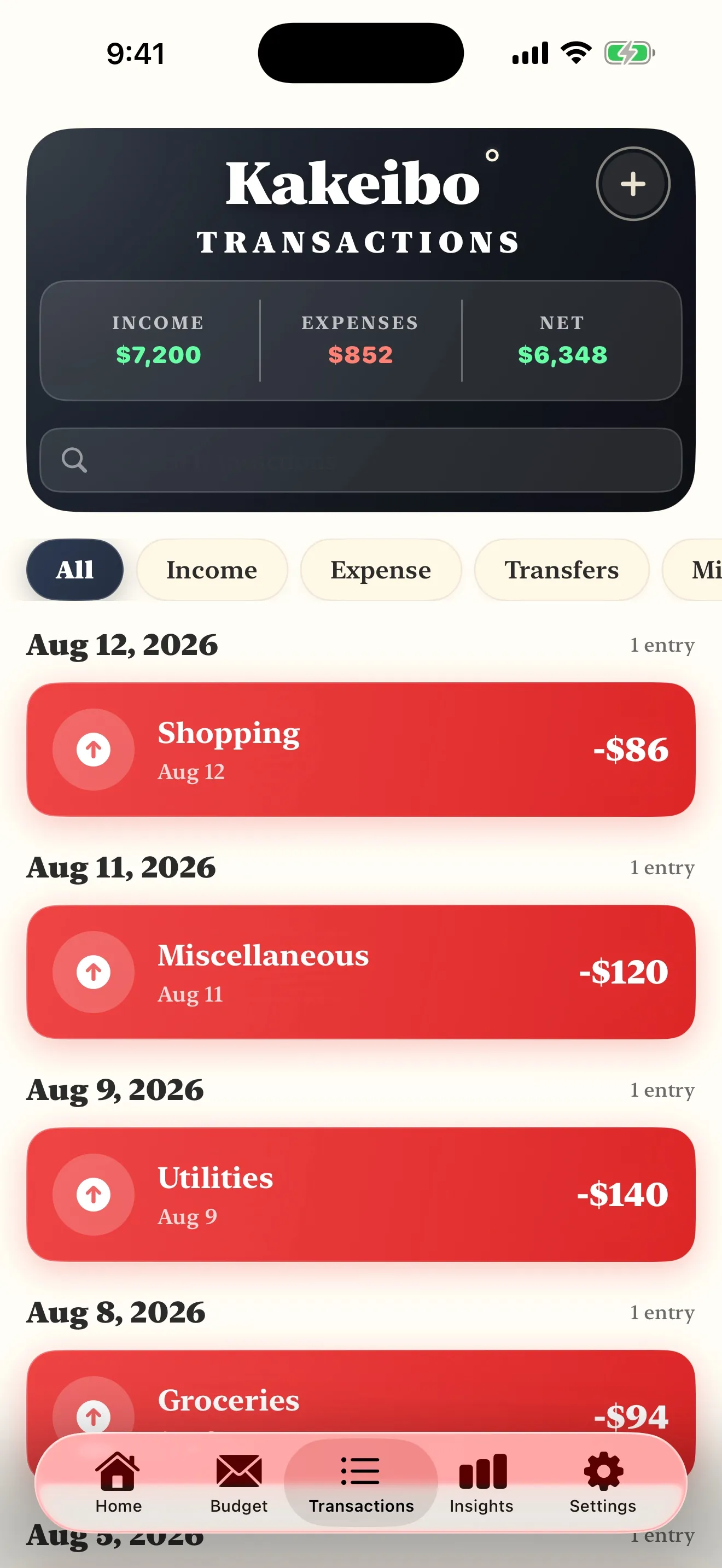
- Use whichever ledger you both actually open. A single shared notebook that lives in one place works if you are both home to write in it. A shared app account works better once either of you spends away from the house, which for most households is most days.
- Say the amount out loud at the counter if the other person is there. It costs nothing and it means the entry gets made by whoever has their phone out, not whoever technically bought the coffee.
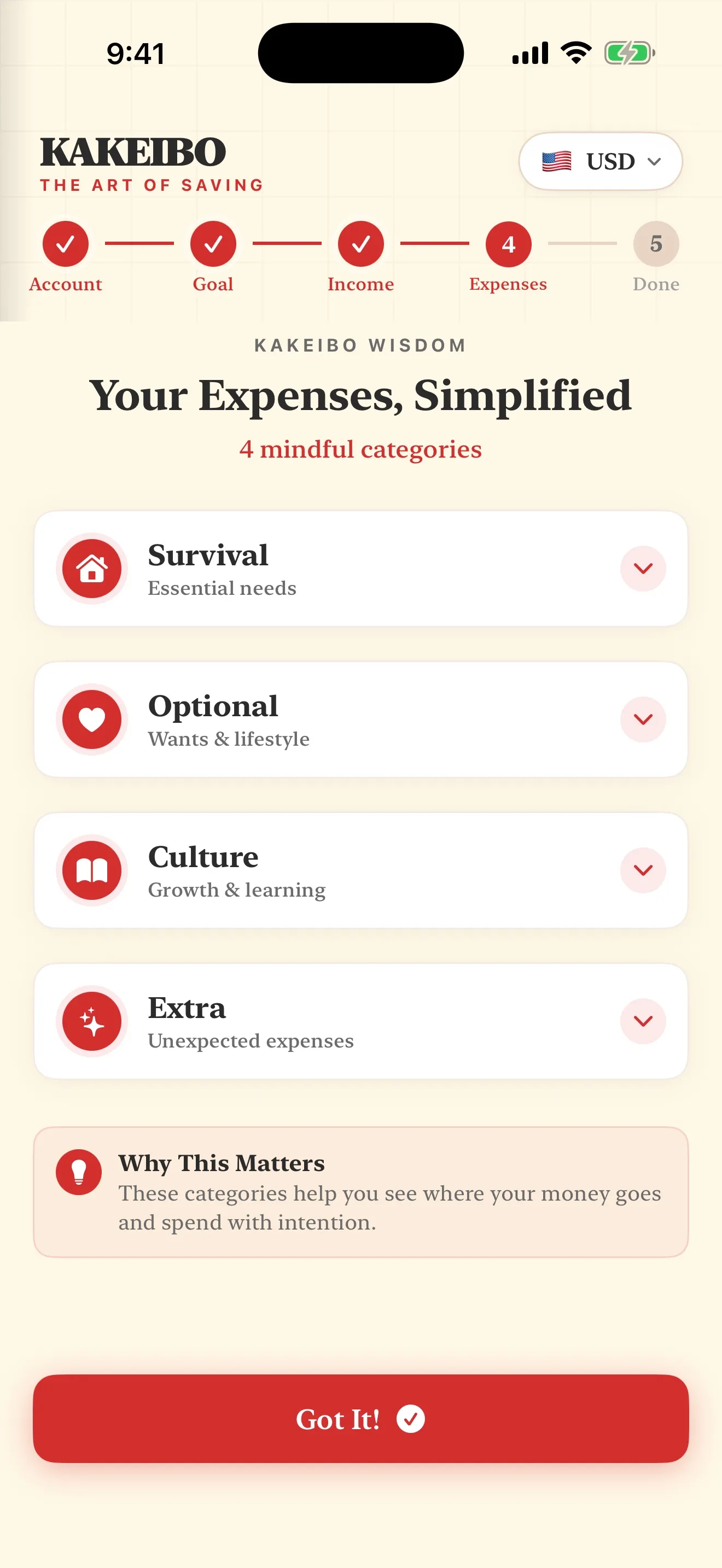
- Agree on the four envelopes once, together, so that Tuesday night's takeaway lands in Optional for both of you rather than in whichever category felt right to whoever was holding the pen. The working list in the four categories guide is worth reading as a pair before your first month starts.
Splitting the four envelopes when incomes differ
Two incomes rarely arrive in equal amounts, and the fairest split of shared costs is a genuine decision rather than an obvious default. Two approaches cover almost every household.
Proportional to income. If one partner earns 4,500 a month and the other earns 3,000, shared Survival costs split 60/40 rather than 50/50, so that each partner keeps roughly the same share of their own income free afterwards. This is the more defensible option once the gap is large, because a straight even split quietly asks the lower earner to give up a bigger slice of what they make.
Even, regardless of income. Simpler to run, and common where the gap is small or where both partners would rather treat the relationship as the unit rather than the two incomes inside it. Neither approach is the method's answer, because kakeibo does not have one. What it insists on is that the two of you agree to a split once, write it down next to the ledger, and revisit it the month either income actually changes, rather than renegotiating it every time a bill feels heavy.
Whichever split you choose, run the combined number through the kakeibo calculator with both incomes added together. It takes the household's total income, takes the joint savings promise off the top the way the method insists, and divides what is left across the four envelopes, which is the number the split above then gets applied to. If the two of you are saving toward one goal, such as 5,000 dollars in a year, working out the monthly figure first makes the split an easier conversation, because you are dividing a number you have already agreed on rather than arguing about the number itself.
The four envelopes, once you are two people
Survival is almost always shared: rent, utilities, groceries, the costs that exist whether one person lives there or two. Extra is usually shared too, since a car repair or a vet bill rarely belongs to one partner alone. Optional and Culture are where couples most often want some personal room, and giving each partner a small personal allowance inside those two envelopes, spent with no explanation owed, is a reasonable adaptation. It is not in the original method, and it should be named as an adaptation rather than passed off as kakeibo proper, the same way the credit card guide names its own adjustments for cards and digital payments. What matters is that the personal allowance still gets logged in the shared ledger. A spending line that is invisible to the other partner is exactly the blind spot kakeibo exists to remove.
The monthly reflection, done together
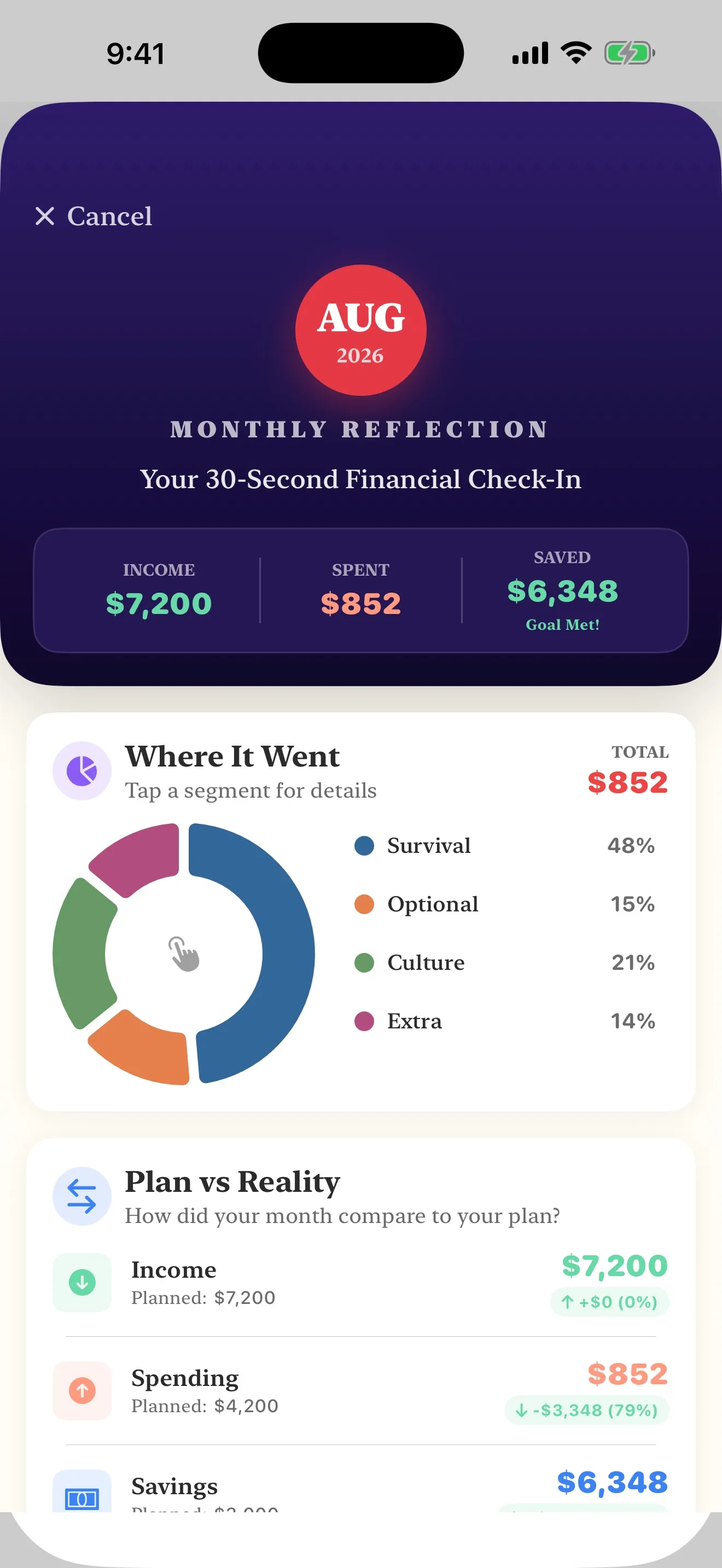
Run the four questions as a conversation, at the same time, rather than as two separate reports compared afterwards. The order still matters: how much came in, how much you agreed to save, how much actually went out, and what you would change, in that sequence, with both of you present and the ledger open. The full prompts are set out in the four questions guide, and none of them change for two people except the pronoun.
What does change is the tone the reflection needs to hold. "Where did the money go" is a different question from "who spent it", and a couple's reflection has to stay firmly on the first one. Ask what surprised both of you, not what one partner did wrong. A reflection that turns into a list of complaints about the other person's spending will get skipped next month, and a skipped reflection is worse than an imperfect one.
Choose one change for the coming month, not one change per person. Two independent changes running at once mean neither of you can tell which one actually moved the number, and a couple correcting for two different things at the same time is usually correcting for neither.
When you disagree
You will, and the ledger is what turns the disagreement into something you can actually resolve. Two habits keep it useful rather than corrosive.
- Argue about the category, not the character."Should this be Culture or Optional" is a five minute conversation with a clear answer. "You always spend on things we don't need" is not a conversation, it is a verdict, and it will not survive being said twice.
- Bring the disagreement to the monthly reflection rather than the moment of the purchase. The entry itself should take seconds. Whether it was the right purchase is a question for the fifteen minutes you have set aside to ask it properly, with the whole month in view rather than one receipt.
A workable setup for two
- Agree the split of shared costs once, in writing, before the first month starts.
- Move the joint savings promise out on payday, automatically, before either of you sees the rest.
- Each partner logs their own spending, at the time, into the same shared ledger.
- A small personal allowance inside Optional or Culture is fine, provided it is still entered where the other partner can see it.
- Once a month, the four questions, together, with the ledger open and the split from step one there to check against.
- One change for the month, agreed jointly, written down so next month can tell you whether it worked.
None of this contradicts the ledger Hani Motoko published in 1904. It was designed to give the person keeping it a documented say over household money, and the version for two people simply gives that say to both of you, in the same book, rather than to whichever one of you happens to hold the pen. The method itself is set out in full at what is kakeibo.
Common questions
- Should couples keep one kakeibo ledger or two separate ones?
- One. Two ledgers produce two partial accounts of the same household, and neither partner can answer the question kakeibo is built to answer, which is where the money actually went this month. A shared ledger with both people entering into it is the only version that works.
- Who should keep the book if only one partner is good with money?
- Neither partner keeps it for the other. The recording is what changes behaviour, so the person spending has to be the person writing it down. A household where only one person makes entries is a household where only one person is doing kakeibo, whatever the ledger looks like.
- How do you split the four envelopes when incomes are different?
- There is no rule the method hands you. Splitting shared costs in proportion to income is the more common approach when the gap is large, an even split is simpler when it is small, and either is defensible so long as you agree to it once, in writing, and revisit it if either income changes.
- What if we disagree at the monthly reflection?
- Pick one change, not two, and choose it together rather than assigning it. A reflection that ends in a single agreed sentence is doing its job. One that ends in a list of things the other person should stop doing has stopped being a reflection and started being an audit.
- Does kakeibo still work with fully separate bank accounts?
- Yes. The method describes what gets logged and how it gets sorted, not how the underlying accounts are structured. Separate accounts and a shared ledger are not in conflict, provided every household expense from either account lands in the same four envelopes.
 SortingThe four kakeibo categories explainedSurvival, Optional, Culture and Extra, with a working list of everyday expenses sorted into each one and the awkward cases argued out.9 min read
 Modern moneyHow to do kakeibo with a credit card and digital paymentsThe main practical objection to a 1904 paper method, answered properly: cards, subscriptions, buy now pay later, and the two week lag between the decision and the money.8 min read
 ReflectionThe four kakeibo questions, and prompts for the weekly and monthly reviewThe four questions in the order the method asks them, plus a short weekly check and a longer monthly reflection you can work through in fifteen minutes.10 min read
Two people, one ledger, one honest month
Split the shared costs once, log your own spending as it happens, and run the reflection as a conversation. That is the whole adaptation this method needs for two.